
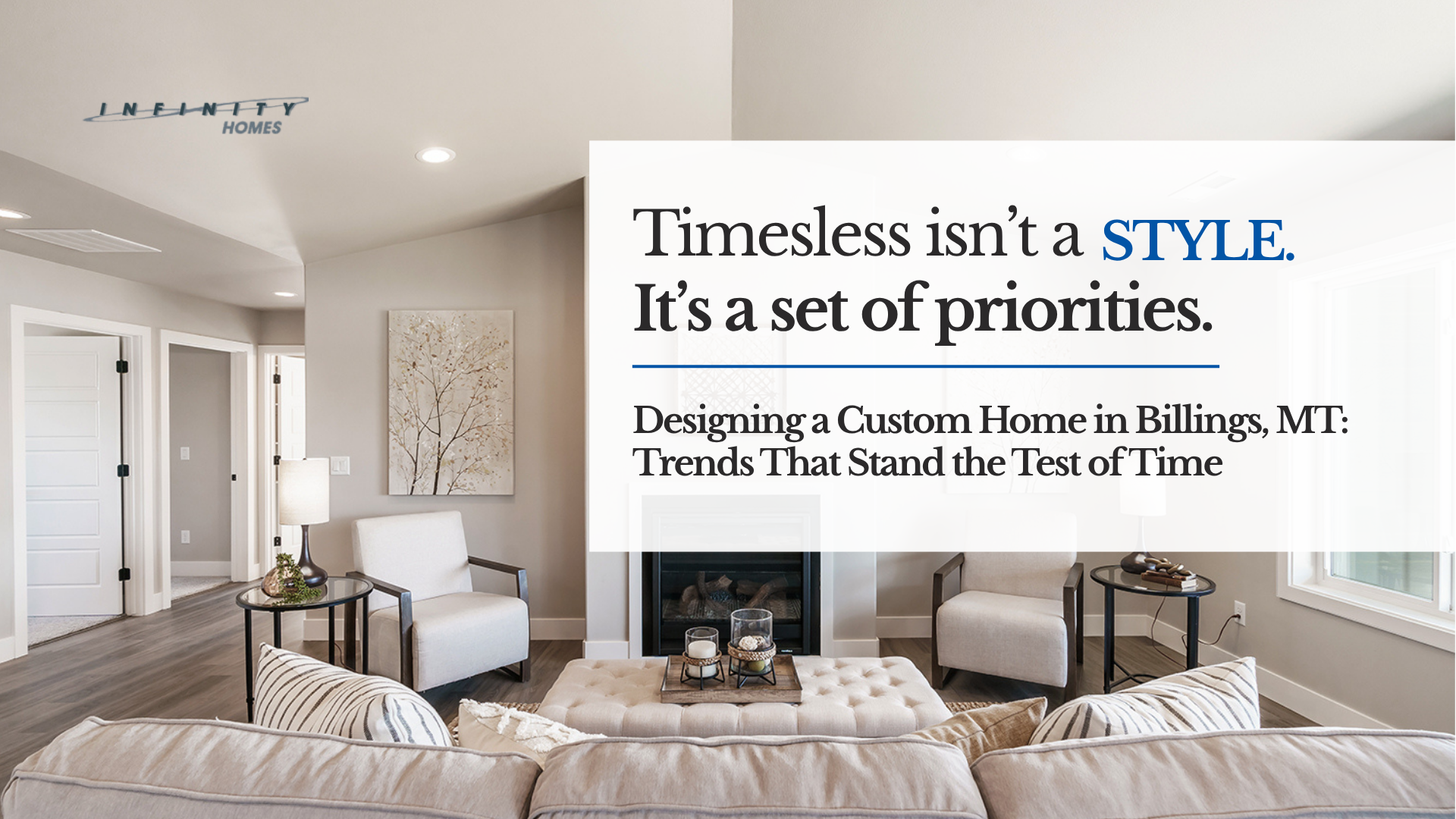
You’ll live in this house for twenty years. The trend you’re looking at right now has about four left in it.
That’s not an argument against style — it’s an argument for knowing which decisions are permanent and which ones aren’t. Get that sorted and you can chase whatever you want in the places where it’s cheap to change your mind.
Here’s how to design a house in Billings that still looks right in 2045.
The test that sorts everything
Before any design decision, ask one question: how hard is this to change later?
Hard to change — floor plan, ceiling heights, window placement and size, roof lines, exterior materials, where the light comes from, how the spaces flow. These are the house. Get them right and they’ll be right forever, because good proportion and good light don’t go out of style.
Easy to change — paint, light fixtures, cabinet hardware, backsplash tile, faucets, mirrors, furniture. A weekend and a few thousand dollars.
The rule: be conservative and thoughtful on the first list. Have fun on the second.
Almost every house that looks dated got it backwards — it committed something permanent to a moment in time.
What actually stands up
Natural light, planned on purpose
The most timeless thing in any house is light, and it’s the thing people plan the least.
Montana winters are long and the sun sits low. A house oriented with its main living space toward the south collects light through the short days. One that faces the wrong way is dim by three in the afternoon in January, and no amount of recessed lighting fixes that feeling.
This is free to get right at the design stage and impossible to fix later. Talk about it before the plan is drawn, not after.
Proportion over size
A well-proportioned 2,400 square foot house feels better than a poorly proportioned 3,400.
Ceiling heights that relate to room sizes. Windows that line up. Hallways wide enough to pass someone. Doors that don’t collide. None of that photographs dramatically, and all of it is what makes a house feel good to walk through fifteen years in.
Real materials
Wood, stone, tile, metal. They age. That’s the point — they get better looking as they wear, and they can be refinished instead of replaced.
Materials designed to imitate something else tend to age in the opposite direction, and they usually date themselves to the decade they were made.
You don’t need real materials everywhere. Put them where you touch things and where you look at things: floors, counters, the front door, the fireplace surround.
Storage, and more than you think
Nobody has ever complained about too much storage.
Pantry, linen closets, a real coat closet, garage shelving, somewhere for holiday decorations, somewhere for luggage. Storage is invisible on a plan and enormously felt in daily life. It never goes out of style because it isn’t style.
A layout that works when your life changes
The house that works for you at 40 should still work at 65.
A main-floor primary bedroom is the big one. Wide doorways, a curbless shower, a zero-step entry somewhere on the house — none of these look institutional if they’re designed in from the start, and all of them get expensive to add later.
You may never need any of it. Your parents might, when they visit or when they move in.
Montana-specific things that are always right here
These aren’t trends. They’re what living here demands.
A serious mudroom
Boots, coats, snow, mud, dog, gear. A hook by the front door is not a mudroom.
You want a real drop zone off the garage: bench, hooks, cubbies, a floor you can hose off, ideally a spot for wet boots that isn’t the middle of the floor. If you’ve lived here through a winter you already know why.
This is the single most requested thing on our builds and the single most regretted omission.
Covered outdoor space
A deck with no cover gets used three months a year. A covered patio or porch gets used seven.
Shade in July, dry in a shoulder-season rain, snow-free in the fall. It extends the season more than anything else you can build, and it never looks dated because it’s just a roof.
Roof pitch and where the snow goes
Where snow sheds is a design decision, not an accident. You don’t want it dumping on your entry, your walkway, your deck, or your mechanical equipment.
A builder who’s worked here for a while thinks about this without being asked. Ask anyway.
Windows that perform
Big windows toward a view are worth it. Big cheap windows toward a view are a mistake you’ll pay for every month for thirty years.
Billings gets wind, real temperature swings, and hail. Spend on the glass package and the installation. This is a permanent decision and it’s one of the few places where the expensive answer is almost always right.
Shop and garage space
Whatever you think you need, you’ll fill it.
A third bay, a deeper bay for a truck, a heated shop. In Montana this is genuinely functional space, not indulgence, and it holds value in resale better here than almost anywhere.
Trends worth being careful with
Not banned. Just — think about where you put them.
All-white or all-gray everything. Reads clean now, reads like a specific decade later. Neutral is safe; monochrome is a statement, and statements date.
Open shelving in the kitchen. Beautiful in photos. Requires that your dishes always look styled and never get dusty. Some people love it for years. Most people put doors back on.
Barn doors. They had a run. They don’t seal sound, they don’t seal light, and they’re a strong stylistic commitment for a piece of hardware.
Fully open floor plans with nowhere to hide. Great rooms are great until two people want to do two different things. The correction is already underway — people want a door they can close. A small office, a den, a room with a real wall.
Very specific tile. A dramatic patterned tile is a wonderful thing on a small powder room floor. It’s a fifteen-year commitment on a whole main level.
Statement plumbing finishes. Matte black, unlacquered brass, whatever’s next. These are actually fine, because fixtures are easy to swap. Just don’t let a finish drive a permanent decision.
Where to put the trend
Here’s the practical version of everything above.
Commit permanently to: simple roof lines, good light, honest materials, sound proportions, a layout that works, real storage, a mudroom that means it.
Play in: paint, hardware, light fixtures, faucets, backsplash, powder room, mirrors, furniture, the front door color.
That way when you get tired of something — and you will — the fix is a weekend and a few hundred dollars instead of a remodel.
Two questions to ask yourself before you finalize plans
“Would this have looked good in 1995, and will it look good in 2045?”
Not every timeless thing passes this, but almost everything that fails it is a trend. A gabled roof, a wood floor, a well-placed window — those pass in any decade.
“Am I designing for a photo or for a Tuesday?”
Both matter. But you live in the house on Tuesdays. Every design decision that only works when the house is staged is one you’ll fight for twenty years.
The bottom line
Timeless isn’t a style. It isn’t farmhouse, or modern, or mountain contemporary. Those are all trends, and all three will read as dated eventually.
Timeless is a set of priorities: light, proportion, real materials, and a plan that fits how you actually live. Get those right and the house works regardless of what’s on the walls.
Then paint the walls whatever you want. You can always change it.
Infinity Homes builds custom homes in Billings, Belgrade, Helena, and Great Falls. If you’re in the design phase and trying to sort the permanent decisions from the reversible ones, we’re happy to walk through it with you.
